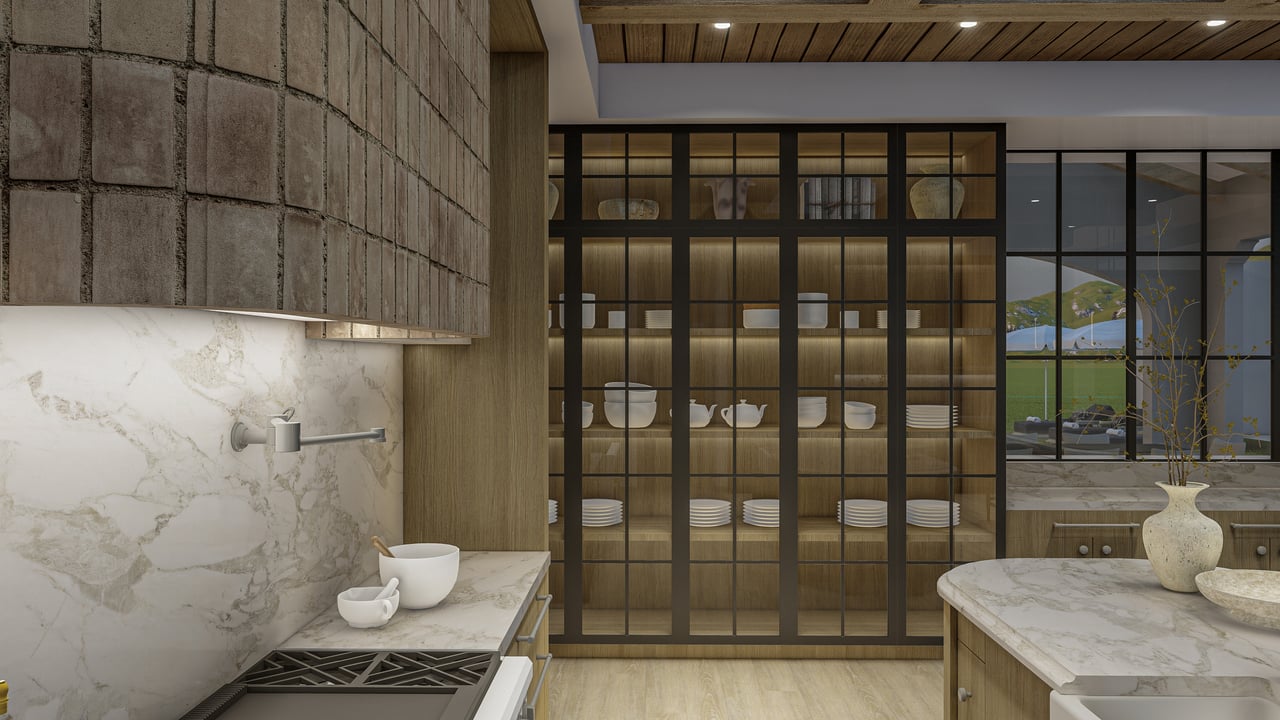
Why Today’s Luxury Buyers Are Investing in Homes That Not Only Impress—They Perform
The investment case for performance-driven design in Paradise Valley and Scottsdale
Real estate has always been an investment.
But the metrics that define a strong investment—especially in the luxury segment—are evolving.
Visual impact. Square footage. Statement finishes.
These still matter.
But they are no longer sufficient.
Luxury is shifting from how a home looks to how it lives.
The Market Is Recalibrating
Across the upper tier of both Paradise Valley and Scottsdale, a clear distinction is emerging between two categories of homes:
- Homes designed to impress at the point of sale
- Homes designed to perform over time
Sophisticated buyers are recognizing the difference.
They are no longer evaluating a home based solely on its visual presentation today—they are evaluating how it will hold up:
- Structurally
- Functionally
- Financially
…over the next 10–20 years.
Scarcity Creates the Floor
At a macro level, both Paradise Valley and Scottsdale benefit from powerful supply-and-demand fundamentals.
Paradise Valley
- One-acre minimum zoning across most of the town
- No commercial intrusion
- No high-density housing
- Approximately 16 square miles of fully built-out land
Scottsdale
- One of the most desirable relocation markets in the U.S.
- Direct adjacency to Phoenix’s economic engine and innovation corridors
- Proximity to Arizona State University—one of the largest public universities in the country and a driver of talent and innovation
- Renowned lifestyle: golf, hiking, wellness, and year-round outdoor living
Demand continues to rise—from both primary residents and second-home buyers—while land supply remains fixed.
That combination creates a structural floor under long-term value.
Design Quality as a Multiplier
Within a constrained market, however, not all homes perform equally.
This is where a second layer of investment analysis comes into play:
Design quality is not aesthetic—it is financial.
Homes built with Organic-Luxe principles—integrity of structure, authenticity of materials, and alignment with environment—demonstrate more consistent long-term performance.
Why?
- They are not trend-dependent, so they avoid rapid obsolescence
- Natural materials age with character rather than deterioration
- Floorplans support real living patterns, not staged ones
- Environmental responsiveness enhances daily comfort over time
By contrast, homes built primarily for visual impact often require reinvestment as trends shift.
What feels “current” today can feel dated in surprisingly short cycles.
The Buyer Who Is Paying Attention
The most informed buyers in today’s market are not chasing finishes.
They are evaluating:
- How the home functions day-to-day
- The integrity of construction and engineering decisions
- The durability and authenticity of materials
- The relationship between the home and its setting
- The long-term livability for their family
- The impact of the home on health and wellness
These buyers are not reacting to the market.
They are anticipating where it is going.
The Long View
After more than 40 years in real estate, one pattern remains consistent:
The homes that hold value—and that families remain connected to over generations—are not the ones that chased design trends.
They are the ones built with clarity of purpose.
Organic-Luxe is not a trend expression of luxury.
It is a return to fundamentals.
A Personal Perspective
In 2008, I had the privilege of serving as Chair of the Arizona Chapter of the U.S. Green Building Council.
At that time, the Leadership in Energy and Environmental Design (LEED) certification system was still emerging. Building to higher standards—healthier materials, improved air quality, and more thoughtful environmental design such as using local sources—often came at a noticeable premium. For many, it was a difficult value proposition.
Today, that equation has fundamentally shifted.
Luxury buyers increasingly understand that health and wellness are not abstract benefits—they are tangible, measurable, and deeply personal. Homes that support better air quality, reduced toxins, and more stable environments are not only more enjoyable to live in—they can contribute to lower long-term medical costs and improved quality of life.
What once felt like an added expense is now being recognized as a prudent investment—financially, physically, and emotionally.
The market has caught up to what forward-thinking design has been pointing toward for years.
Featured Properties in Scottsdale & Paradise Valley
4901 E. Berneil Drive, Paradise Valley, AZ 85253
New Construction | Completion May 2026 Presale Pricing $ 8,920,000 (Learn More)
6302 E. Alta Hacienda, Scottsdale, AZ 85251
Fully Remodeled | Completion July 2026 Presented at $ 8,755,000 (Learn More)
Organic-Luxe™ begins with natural materials, thoughtful architecture, wellness-centered design, and a deep respect for the relationship between people and the built environment.
For private opportunities and luxury home representation:
Denise van den Bossche
Associate Broker | Legacy LEED AP | Realty Executives Arizona Territory, team Exec-Elite
602-980-0737